
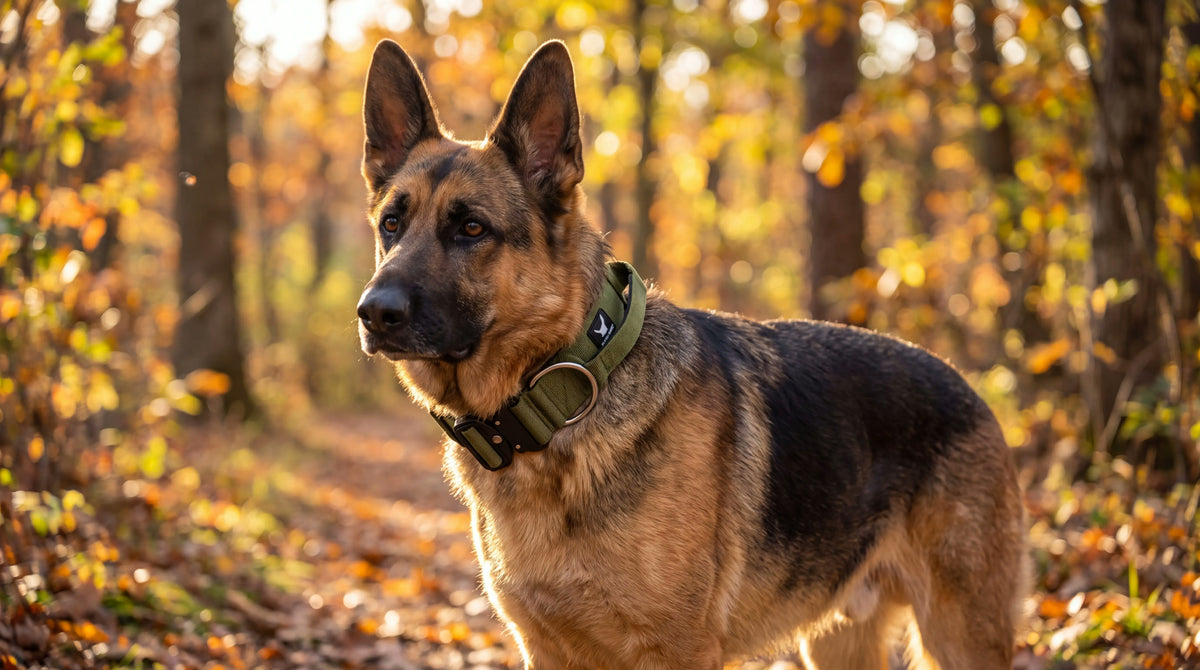
The short answer: Size L (45–66 cm) – an adult German Shepherd has a neck circumference of 50–60 cm. Add to that 5 cm width, padding on the inside, a metal buckle, and a handle at the back of the neck. Readjust the fit when the coat sheds: two fingers flat under the collar.
The German Shepherd is one of those dogs whose gear really has to perform. They bring strength, love to work, have a coat that changes completely twice a year – and are often handled in settings where fast, calm control matters. This guide walks through what specifically matters in a collar: measurements, width, buckle, and the points that are especially relevant for this breed.
What Size Does a German Shepherd Need?
The neck circumference of an adult German Shepherd is typically between 50 and 60 cm. Males are usually at the upper end, females tend to be below. Working lines with pronounced neck muscles can measure a bit more.
| Weight | Neck circumference (guideline) | Matching size | |
|---|---|---|---|
| Female | 22–32 kg | 48–55 cm | M or L |
| Male | 30–40 kg | 52–60 cm | L |
| Young dog from 6 months | depending on growth | 40–50 cm | M (from 43 cm), adjusted to grow with the dog |
In most cases, you'll end up with size L for an adult German Shepherd – wide dog collar for large dogs (45–66 cm, continuously adjustable). Only for petite females can size M be the better choice.
The table doesn't replace measuring. How to measure correctly is explained step by step in our size guide – including the four mistakes that happen most often.

The Coat: Why One Measurement Isn't Enough
With the German Shepherd, there's one point you don't know from short-haired breeds: The measured neck circumference varies by several centimeters over the year. The stock coat with its dense undercoat builds up in the fall and is shed in the spring.
Two things follow from this:
- Measure with the coat lightly pressed down. Otherwise, in winter you'll be measuring the undercoat as well and order too large.
- When in doubt, choose the larger size. You can set a continuously adjustable collar tighter in summer and looser in winter. A collar that's too small, on the other hand, can't be made bigger.
After every coat change, briefly check the fit. Two fingers flat between neck and collar – that's the whole check.
With long stock coats, the collar also flattens the fur over time. That's cosmetic, not a health issue. If you want to avoid it, take the collar off at home – which makes sense anyway.
Width: Why 5 cm Makes Sense for This Breed
An adult German Shepherd weighs between 22 and 40 kilograms and can set this mass in motion very quickly. When such a dog suddenly lunges into the leash, the resulting pull is distributed over the surface that rests against the neck.
A 5 cm wide webbing distributes this pull over twice the area of a 2.5 cm strap. This halves the pressure per square centimeter. That's the real reason for wide collars – not the looks.
At the same time, width has a limit: Too wide restricts head movement and gets in the way while working. For a dog with a German Shepherd's neck circumference, 5 cm is the width that best balances pressure distribution and freedom of movement. More detail is in the post How Wide Should a Dog Collar Be?.
The Grab Handle: More Than an Accessory for This Breed
German Shepherds are often handled in situations where quick, calm intervention within seconds matters: narrow passages, encounters with other dogs, crowds, the vet, training. A sewn handle on top of the collar – our dog collar with handle has one as standard – lets you grab right at the neck instead of pulling via the long lever of the leash.
The difference in practice:
- Without a handle: You take up the leash, shorten it, pull – the dog feels pressure on the neck, often pulling back in response.
- With a handle: You grab it, have your dog under control immediately, and can guide or hold them without yanking.
Important: The handle is for guiding and holding, not for lifting. Lifting a dog by the collar is not okay at any size.
So that the handle is where your hand reaches in an emergency, the collar should sit so that the handle lies at the back of the neck – not twisted to the side.
Joints: Why Sudden Jerks Are Especially Unfavorable for This Breed
The German Shepherd is a breed for which hip dysplasia is a well-known issue. Reputable breed clubs screen for it, but the risk can't be ruled out.
For the gear, this means: Avoid anything that creates sudden jerking forces. Specifically, that means no long line on the collar – when the dog runs to the full length, it creates a jolt that has no business on the neck or on the musculoskeletal system. Long lines belong on a well-fitting harness.
This doesn't apply to the normal leash on the collar. A well-fitting, wide collar is unproblematic in everyday life for a dog that doesn't constantly pull into it with full body weight. However, if your dog pulls constantly, that's a training issue, not a gear question – more on this in the post When Your Dog Pulls on the Leash.
Buckle and Hardware
With a dog in this strength class, durability isn't decided by the webbing but by the connection points. What you should look for:
| Component | Requirement |
|---|---|
| Buckle | doesn't open under sudden pulling or when getting caught |
| D-ring | metal, cleanly sewn in, matching the leash carabiner |
| Seams | sewn rather than glued or riveted, ideally with cross stitching |
| Padding | soft on the inside so nothing chafes with a dense coat |
We give our anti-break warranty on buckles, carabiners, and rings – in a warranty case, we repair or replace instead of you having to buy a new collar.
Young Dogs: The First Eighteen Months
A German Shepherd looks almost fully grown at around twelve months, but muscles and joints keep developing until about eighteen months. For the gear, this means three things:
- The neck circumference grows in spurts. Between the sixth and twelfth month, it can increase by ten centimeters. A continuously adjustable collar covers this; a model with a row of holes jumps in coarse steps and doesn't fit properly half the time.
- The two-finger test every week. During the growth phase, this isn't extra effort but routine – ten seconds when putting the collar on.
- No pulling on an unfinished frame. As long as a young dog still lunges into the leash with full body weight, a well-fitting harness is the gentler choice. The collar comes in once loose-leash walking is solid.
For young dogs of large breeds, it's usually worth going straight for the size the dog will grow into, even if it has to be set tight at first – growing into it is easier than buying again.
Work, Sport, and Everyday Life: Different Requirements
The German Shepherd is actually worked more often than other breeds – in tracking, in dog sports, in search and rescue. That changes the requirements for the gear, but differently than many people think.
What Differs
| Situation | What matters |
|---|---|
| Everyday life, city | quick access, secure buckle, low-key look |
| Tracking, search work | harness instead of collar – the dog works forward in the direction of pull |
| Obedience, heelwork | collar, so subtle signals come through directly; short leash |
| Transport, waiting times | short leash, dog stays close to you |
The point that regularly gets muddled in forums: A tactically designed collar doesn't turn any dog into a service dog, and it's not a piece of gear you have to "earn" either. What it does is simply distribute pressure and give you quick access – useful in everyday life with a strong dog, regardless of whether they're handled in sports or not.
Visibility at Dusk
A dark German Shepherd on a field path in the fall is practically invisible. The collar doesn't solve that – a 5 cm wide webbing is not a signal surface. If you're out in the dark a lot, combine it with a light-up collar or a reflective vest. Bright colors like Orange can be spotted earlier at dusk; in complete darkness, only light or reflective material helps.
The Matching Leash
For everyday life with a German Shepherd, two options have proven themselves:
- A dog leash with padded hand loop and a fixed length of 140 cm for normal walks. The padded loop is no luxury in this weight class – when a 35-kilo dog suddenly lunges into the leash, a narrow, unpadded loop transfers the entire force onto a narrow line across your palm.
- A 3-way adjustable leash up to 2.5 m if you switch a lot between the city and open terrain or need your hands free.
For train platforms, pedestrian zones, or the vet's waiting room, a short leash (traffic leash) for dogs rounds things off nicely. Which length and width fits when is explained in the guide Dog Leash: Length, Width, and Material.
Frequently Asked Questions
What collar size does a German Shepherd need?
The neck circumference of adult dogs is usually between 50 and 60 cm, with males tending toward the upper end. So in the vast majority of cases, size L fits. For petite females, size M may be enough. Measure before ordering.
How wide should the collar be for a German Shepherd?
5 cm. For a dog between 22 and 40 kg, wide webbing distributes the pull over twice the area of a narrow one, halving the pressure per square centimeter. Much wider would be unnecessary and would restrict head movement.
Do I need two collars because of the coat change?
No. A continuously adjustable collar covers both states – set tighter in summer, looser in winter. What matters is checking the fit once after every coat change.
Is a collar harmful for dogs with hip problems?
A well-fitting, wide collar is unproblematic in normal everyday life. What you should avoid are sudden jerking forces – especially a long line on the collar. That belongs on the harness. If your dog pulls constantly, it's a training issue, not a gear issue.
Why does a German Shepherd need a grab handle on the collar?
To be able to intervene directly at the neck in tight situations instead of pulling via the long lever of the leash. With a strong, fast-reacting dog, that's the difference between guiding and yanking. The handle is not meant for lifting.
Related Reading
About us: Amie Wear is a small team of two dog owners with four dogs who develop tactical collars and leashes for strong dogs. All recommendations are based on our own everyday experience with large dogs and feedback from our customers. Learn more about us.


